ChatGPT is telling your customers when you're open. Is it right?
I asked ChatGPT a simple question last week: what hours is Walmart in Union City open?
It answered in about two seconds. Open until 11 tonight, 6 AM to 11 PM every day, the street address, the phone number and the sensory-friendly shopping hours, with a link to Walmart's store page.
Then I asked it about my own business, TameBuild, in the same town. It asked whether I meant a builders supply store down the road.
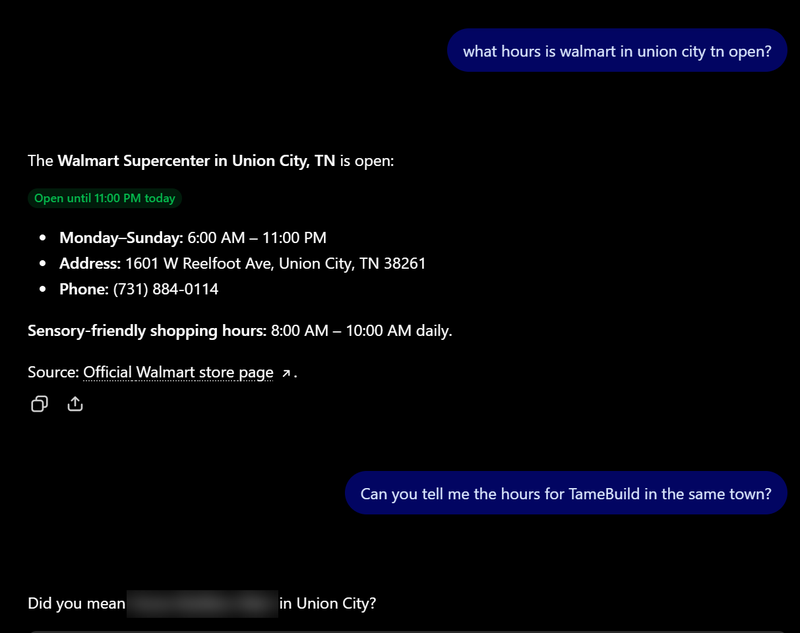
That's the whole problem in two questions. Walmart's information is everywhere and it all matches, so the AI is confident. Mine wasn't anywhere it was looking, so it guessed. If you run a local business, your customers are asking these tools about you right now, and you probably have no idea what they're being told.
Watch the video on YouTube (90 seconds)
Where the answers come from
ChatGPT doesn't know your business. It reads about it, from the same public places a curious customer would check. Your Google Business Profile is the big one. Bing keeps its own business listings, and so does Apple Maps, which is what an iPhone shows when someone asks for directions. After that come review sites, your Facebook page and your own website.
Even people who never open ChatGPT are getting AI answers now. Google puts an AI-written summary at the top of many searches, and it says those summaries reach more than 2 billion people a month. Either way, a machine is reading your information and repeating it to your customers. They get a name, maybe hours and a phone number, and they call. Your website may never get a visit.
When the sources disagree, or there's nothing to read, the AI guesses. Sometimes it picks the old hours. Sometimes it offers the business down the road.
What I found when I checked
This summer I checked 8,931 small business websites around the country. 828 of them had something badly wrong, like a site that wouldn't load or a domain that had lapsed into a page offering it for sale.
An AI that tries to read one of those sites comes away with nothing. Or worse, it comes away believing the business is gone.
What happened when I fixed my own
Until this month there was nothing to claim on ChatGPT. On November 10, OpenAI opened a free beta it calls Businesses in ChatGPT. Owners sign in, open the Business Hub and search for their business. If it's there, you claim it. If it isn't, you create it.
TameBuild wasn't there under either name I tried. ChatGPT doesn't pull from Google, so I started a new profile through the website option. It had me add a small verification record to my domain settings and verify my identity, and then I typed in the rest from my Google profile. It asked for a street address and never said whether that address would be shown to anyone. As I write this, I'm still waiting on approval.
Bing took the least effort. Bing Places now lives at bing.com/forbusiness, and it pulled in my Google profile for me.
Apple is next on my list. Its tool is now called Apple Business, and it wants an ID check before the listing goes live.
I'll be honest: this kind of setup bores me to tears. I had an AI assistant do most of the clicking and typing, and it still took about two hours, almost all of it signing in and agreeing to terms. It's dull work, and it's the work that keeps you findable now.
I'll ask ChatGPT about TameBuild again once the listing is approved, and I'll add what it says to the bottom of this article.
The half hour that fixes most of it
Check your Google Business Profile. Hours, holiday hours, phone number, website link and the category you're listed under. Add a few recent photos of your actual storefront or your actual work. If you haven't logged in this year, start here. Google's AI answers lean on it heavily, and many other tools copy from the same public facts.
Claim your Bing and Apple listings. Both are free. Bing can import your Google profile. Apple's tool is now called Apple Business.
Claim or create your ChatGPT listing. It's free for now and brand new. Have your website login handy if you need to create one from scratch.
Put the basics on your website as plain text. Your name, your address or the area you serve, your phone number and your hours, typed out on the page. AI reads text. A nice graphic with your hours baked into it is invisible to it.
Answer the questions people actually ask. If customers keep calling to ask whether you take walk-ins or work on diesels, put the answer on your site. Those are the questions people type into an AI now.
Ask for reviews, and answer the ones you get. Recent reviews tell an AI you're open and active. A business whose last review is from 2022 looks closed, to people and to machines.
What doesn't work
Don't give up on Google. Most of your customers still use it, and its AI answers read your Google profile first.
You also can't control what an AI says. Anyone who promises to get you "ranked in ChatGPT" is selling something they can't deliver. Even OpenAI's new listings don't promise placement; the reports on the launch say claiming doesn't guarantee it. And with every fact right, an AI can still get you wrong now and then. What you control is what it reads. Getting the public facts right, and the same everywhere, is most of what anyone can do.
What to do this week
- Ask ChatGPT when you're open and what your phone number is.
- If anything's wrong, fix your Google Business Profile first.
- Then claim your Bing, Apple and ChatGPT listings while you're at it.
Hit reply and tell me what the AI said about you. I read every one.
If you'd like a second set of eyes, I'll check your website and Google listing for free: https://buy.stripe.com/5kQ5kEdeNawO0Y14Uj97G0c?prefilled_promo_code=WEEKLYAUDIT. And if your Google listing is wrong and you'd rather not deal with it, I'll fix it for $149 flat.
One more thing this week: the first business to request a free audit, from this article or any of my posts, gets its Google Business Profile cleaned up and optimized by me at no cost, a $149 value. The offer ends November 20, 2026.